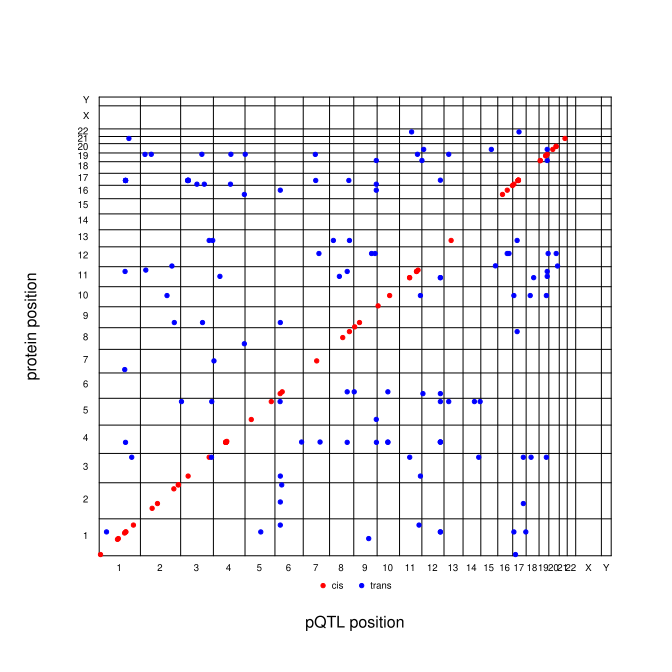
This function assesses whether query loci are novel or match known loci by combining genomic proximity (± flanking window) and linkage disequilibrium (LD).
Usage
novelty_check(
  known_loci,
  query_loci,
  ldops = NULL,
  flanking = 1e+06,
  pop = "EUR",
  verbose = TRUE
)
Arguments
- known_loci
Data.frame of known/published loci. Must contain columns: chr, pos, uniprot, rsid, prot.
- query_loci
Data.frame of query loci to evaluate. Must contain columns: chr, pos, uniprot, rsid, prot.
- ldops
Optional list specifying local LD computation:
- bfile
PLINK binary prefix (bed/bim/fam)
- plink
Path to PLINK executable
- flanking
Genomic window (bp) around query loci used for overlap. Default is 1e6 (±1 Mb).
- pop
1000 Genomes population code (e.g., "EUR") used when ldops = NULL.
- verbose
Logical; if TRUE prints missing LD variants.
Details
It supports:
1000 Genomes LD reference via ieugwasr
Local PLINK reference panels via ld_matrix_local()
The function:
Finds overlapping loci within a flanking distance
Matches loci by gene/protein (uniprot)
Computes LD (r and r^2) between known and query variants
Returns per-pair LD values for downstream novelty/replication assessment
Examples
if (FALSE) { # \dontrun{
# 1000G mode
novelty_check(known_loci, query_loci)

# Local PLINK mode
novelty_check(
  known_loci,
  query_loci,
  ldops = list(
    bfile = "/path/interval.imputed.olink.chr_3",
    plink = "/path/plink"
  )
)
} # }